|

|
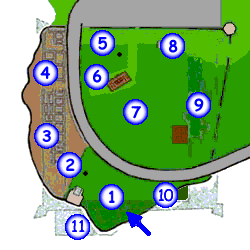
1. Main Gate and Barracks
Welcome to the San Diego Presidio. Join us in a tour
through the west coast's first military encampment and learn
how the Spanish Empire established a stronghold which later became
the city of San Diego. The main gate, at first a primitive
entrance way made of branches, was later strengthened with wooden
beams. Unmarried soldiers lived dormitory- style in barracks
adjacent to the main entrance. Three soldiers stood watch
in a guardhouse where prisoners were held.
(back to list)
|
 |
2. Blacksmith
Artisans were at a premium in San Diego, a place considered
uncivilized compared to the cosmopolitan Mexico City. Nevertheless,
incentives such as land grants, cattle, and promise of a regular
salary attracted a few blacksmiths to the northern frontier.
Blacksmiths fashioned jangles for horses, repaired weapons like
pistols and muskets, hammered out nails, shoed horses, and tinkered
with kitchen utensils. Metal was in short supply and equipment
had to be recycled and re-used.
(back to list) |
 |
3. Houses of Soldiers
& Settlers
The north wing, which began as a row of thatched huts, was
later rebuild according to royal regulations. Each soldier
received a plot of land large enough for a "row" type
house for himself and his family within the north wing.
As the population of the presidio expanded, soldiers utilized
their back yards for additional sleeping areas. First shaded
by a ramada or thatched branch roof, the back yard area was later
enclosed.
(back to list)
|
 |
4. Casa de Zuniga
(Earlier Commandante's House)
Lieutenant Jose de Zuniga, a criollo (of pure Spanish blood
born in New Spain), was a respected leader. He assumed
command of the San Diego Presidio in 1782. His large ten-room
home included an office, formal living and dining rooms, patio,
bedrooms, and even an indoor bathroom, the first of its kind
in California. Letters between Zuniga and his mother, who
lived in Mexico City, show us Zuniga's interests in gardening,
painting, fine wines and even English books.
(back to list) |
|
|
5. Padre Statue
The Padre Statue represents the influence of the Catholic
Church on early efforts to claim Alta California for Spain.
Standing in the patio area of the later commandante's mansion,
the statue reminds us that Spaniards strove to transform natives
into "gente de razon," people of reason. Once
conformed to the Spanish ideals of Catholicism, baptism, marriage
and family-life, Indians would become full-fledged Spanish citizens
ready to defend the territory from possible invasions by English
and Russian forces.
(back to list)
|
 |
6. Later Commandante's
House
Viewed from the sea, the commandante's house stood out on
presidio hill, an elegant structure in sharp contrast to the
small adobe houses of early pueblo San Diego. From 1825-1828,
while Jose Maria Echeandia governed from the commandante's mansion,
San Diego became the state capital.
(back to list)
|
|
|
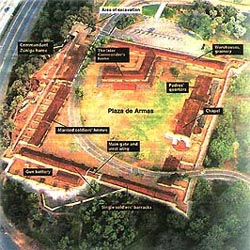
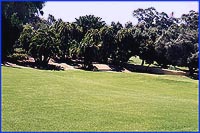
7. The Plaza de Armas
The Plaza de Armas lay below the later commandante's house,
a central meeting place for presidio soldier/settlers and their
families as well as foreign visitors and missionaires.
Bull and bear fights provided entertainment for presidio residents
who watched from rooftops. Once a bull actually jumped
on top of the chapel roof, crashed to the floor and gored a hole
through the wall. Leatherjacket soldiers performed military
drills and jousted with each other in a game called canas (canes).
Using long bamboo canes as mock lances, the soldiers attempted
to knock each other off their horses. Whoever remained
on horseback 'til the end was proclaimed winner. In December,
citizens gathered in the Plaza de Armas to watch costumed performers
present the Christmas pastorela.
(back to list)
|
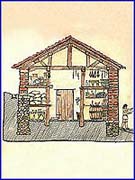 |
8. Warehouses
Inside the warehouses at the southeast corner of the presidio
walls were bags of grain, dried beef, beans and casks of wine
and brandy. Chocolate, sugar and spices sent by ship from
San Blas provided a welcome treat to presidio residents who relied
on visits from abroad for contact with the outside world.
(back to list) |
|
|
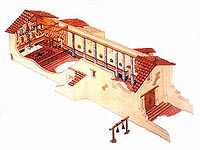
9. Chapel & Padre's Quarters
 Every Sunday men, women and children gathered for
mass at the presidio chapel. Singers stood in a choir loft
above the main congregation area. Priests baptized babies
in the baptistry wing at the south side of the building. On special
relgious holidays members of the Every Sunday men, women and children gathered for
mass at the presidio chapel. Singers stood in a choir loft
above the main congregation area. Priests baptized babies
in the baptistry wing at the south side of the building. On special
relgious holidays members of the 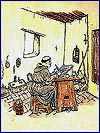 congregation reaceived
communion, though this practice was reserved for preists throughout
the rest of the year because of limited supplies of communal
bread and wine. In the bestry the priest donned special robes
for Christmas, Easter and holy days. Behind the chapel
stood the missionaries' living quarters with additional space
available to accommodate visiting friars from other missions
along El Camino Real. congregation reaceived
communion, though this practice was reserved for preists throughout
the rest of the year because of limited supplies of communal
bread and wine. In the bestry the priest donned special robes
for Christmas, Easter and holy days. Behind the chapel
stood the missionaries' living quarters with additional space
available to accommodate visiting friars from other missions
along El Camino Real.
(back to list)
|
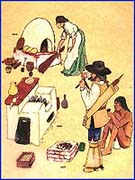 |
10. Colonial
Kitchen
Communal cooking took place in the plaza, especially in the
early days of settlement. Women baked bread and beef or
mutton in the orno (oven), a domed adobe structure covered with
white lime plaster and ventilated in back with three holes. Soldiers
or their wives cooked tortillas on the comal (griddle) on an
estufa (stove). A tripod of three iron stakes stood over
an open fire. On one curved ring hung a caldo (iron pot)
full of beans, corn, chunks of meat and whatever vegetables pioneers
could sustain in their garden plots outside the presidio walls.
(back to list) |
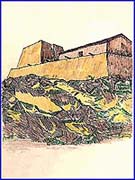 |
11. Gun Battery
With its rammed earth four feet thick walls, the gun battery
housed from four to eight cannons to defend the presidio in case
of attack from the sea. Foreign sea captains like George
Vancouver expressed shock at the presidio's lack of military
defenses. In 1790 officer Miguel Costanso implemented a
royal order to fortify an area below the main entrance with space
for cannons and a supply of cannonballs. Though the cannons
at Fort Guijarros exchanged fire with the American trading vessel
Lelia Byrd in 1803, San Diego Presidio cannons were never fired
in anger and eventually rusted from lack of maintenance.
A 1992 archaeology team uncovered 250 cannonballs buried near
the commandante's mansion--perhaps stashed when Hippolyte Bouchard's
pirates threatened to raid the San Diego Presidio on their way
back to South America.
(back to list)
|