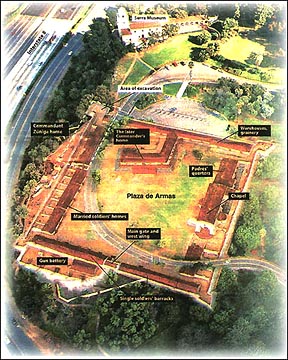
The Presidio of San Diego 1769 - 1835
 At
presidio hill, Father Serra dedicated the first mission in Alta
California on July 16, 1769. Originally constructed of
logs and brush, the San Diego Presidio outpost from 1769 to 1774
consisted of a military base and mission. Then, for a few
reasons, including the mistreatment of Indian women by
Presidio soldiers and need for better agricultural resources,
the mission was relocated six miles up river to the Kumeyaay
village of Nipaguay. The following year, local Kumeyaay
Indians along with Kamia and Quechan allies launched a nighttime
assault on the mission and presidio hoping to drive the Spanish
out of their homeland. They burned the wooden mission to
the ground and killed its leader, Fr. Luis Jayme. For unknown
reasons, a planned simultaneous attack on the Presidio was not
carried out. At
presidio hill, Father Serra dedicated the first mission in Alta
California on July 16, 1769. Originally constructed of
logs and brush, the San Diego Presidio outpost from 1769 to 1774
consisted of a military base and mission. Then, for a few
reasons, including the mistreatment of Indian women by
Presidio soldiers and need for better agricultural resources,
the mission was relocated six miles up river to the Kumeyaay
village of Nipaguay. The following year, local Kumeyaay
Indians along with Kamia and Quechan allies launched a nighttime
assault on the mission and presidio hoping to drive the Spanish
out of their homeland. They burned the wooden mission to
the ground and killed its leader, Fr. Luis Jayme. For unknown
reasons, a planned simultaneous attack on the Presidio was not
carried out.
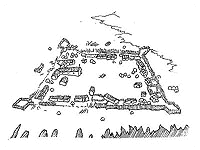 The missionaries and their staff were ordered back
to the relative safety of the fort, and soldiers immediately
laid plans to fortify the Presidio with an outer defense wall
about 300 feet on each side. Rooms with flat earthen roofs
(azoteas) were built inside. From 1776-1781, frontier officials
followed Carlos III's royal instructions and plan for the construction
of the presidios. The defense walls and buildings were now built
of adobe blocks instead of wood. Soldiers would defend each of
the four walls from triangular-shaped bastions on the corners.
A complete community inside included a The missionaries and their staff were ordered back
to the relative safety of the fort, and soldiers immediately
laid plans to fortify the Presidio with an outer defense wall
about 300 feet on each side. Rooms with flat earthen roofs
(azoteas) were built inside. From 1776-1781, frontier officials
followed Carlos III's royal instructions and plan for the construction
of the presidios. The defense walls and buildings were now built
of adobe blocks instead of wood. Soldiers would defend each of
the four walls from triangular-shaped bastions on the corners.
A complete community inside included a  commandant's house, homes for
married soldiers and settlers, a chapel, warehouses, bachelor's
barracks, a guardhouse inside the gatehouse, and a chaplain's
quarters. The mission buildings near Nipaguay were rebuilt
out of adobe and the mission was re-established there in 1777,
its present site. commandant's house, homes for
married soldiers and settlers, a chapel, warehouses, bachelor's
barracks, a guardhouse inside the gatehouse, and a chaplain's
quarters. The mission buildings near Nipaguay were rebuilt
out of adobe and the mission was re-established there in 1777,
its present site.
Several major changes, authored by engineer Geronimo de la
Rocha y Figueroa and directed by post commander Jose de Zuniga,
occurred from 1781-1793. Rocha designed yards (corrales)
outside the presidio buildings which could be converted to new
rooms for additional families. A new defensive wall was
constructed along the exterior of the yards. Zuniga's construction
program included a defense wall beyond the edge of the original
fortifications, a series of backyards for cooking, and a 10-room
commander's residence built around a small patio. Tejas (roof
tiles) and ladrillos (floor tiles) were introduced during the
1780s.
Within three years of Zuniga's departure in 1793, the presidio
was modified again. From 1796-1821 a new barracks was completed
for Catalan troops, and the main gate was moved from the south
side to the center of the western wing. Engineers Miguel Costanso
and Alberto Cordova recommended that a gun battery be built along
the western perimeter to resist pirate raids or European invasion.
During this time, an additional gun battery was also built at
the entrance to San Diego bay below Point Loma. This outpost,
Fort Guijarros, was completed in 1797. 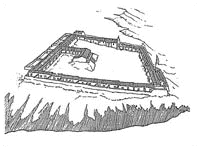 Maintenance work continued
through 1806, but the basic presidio layout remained the same
from 1796 on. Evidence of recycled building materials indicate
changes at the Presidio after 1821 following a period of disrepair.
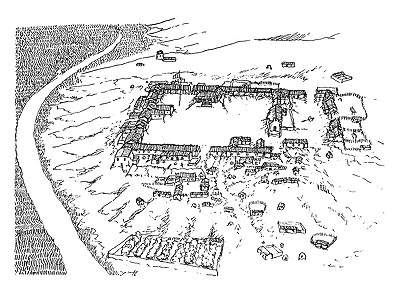
Sometime before 1820 an even more elegant new commander's house
was built upon a cobblestone platform inside the presidio plaza.
Visitors like merchant Alfred Robinson commented on the fine
view of San Diego Bay and surrounding areas from the mansion's
front porch. In 1825 the governor moved the capitol from Monterey
and Presidio San Diego became the capitol of all of Baja and
Alta California At its height, the Presidio's population reached
about 500 persons living within the 300 feet by 300 feet compound. Maintenance work continued
through 1806, but the basic presidio layout remained the same
from 1796 on. Evidence of recycled building materials indicate
changes at the Presidio after 1821 following a period of disrepair.
Sometime before 1820 an even more elegant new commander's house
was built upon a cobblestone platform inside the presidio plaza.
Visitors like merchant Alfred Robinson commented on the fine
view of San Diego Bay and surrounding areas from the mansion's
front porch. In 1825 the governor moved the capitol from Monterey
and Presidio San Diego became the capitol of all of Baja and
Alta California At its height, the Presidio's population reached
about 500 persons living within the 300 feet by 300 feet compound.
Even though Governor Jose Maria Echeandia ordered structural
repairs of the governor's mansion and presidial structures between
1825 and 1828, fortifications deteriorated. Parts of the
outer defense wall were demolished as settlers and soldiers moved
down the hill to Old Town. Soon Old Town residents began
dismantling presidio dwellings for roof and floor tiles.
Many of the exterior rooms were used for trash disposal.
About ten years after the last presidio resident had left, sheep
and cattle kept in makeshift corrals were slaughtered at the
site. Large deposits of discarded bones indicate butchering
activities.
San Diego Presidio Comandante Francisco Maria Ruiz received
the first land grant in San Diego county for "meritorious
service." Like many other recipients of land grants,
Ruiz used Los Penasquitos Rancho (Little Cliffs), a 8,484
acre tract, for cattle grazing. During the Mexican Republic
period, between 1823 and 1846, governors gave friends or relatives
thousands of acres for ranching, Spanish-Mexican military officers
also received plots of land below Presidio Hill and built houses
there, the beginning of Old Town San Diego.
~
by Kathy Hughart & Bill White 1999 |