Cowles Mountain
by Bill White '97
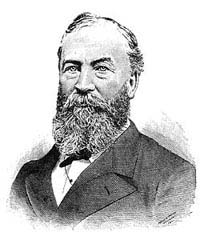
Cowles Mountain (pronounced
"kohls") got its name from George A. Cowles,
one of San Diego's early prominent ranching pioneers. George Cowles
settled in the El Cajon valley in 1877, having first visited San Diego
in 1873, then selecting this area over others he had considered in the
relatively new state of California.
Born April 5, 1836 and raised on a Connecticut farm in Hartford,
his father had been the first to manufacture broadcloth in the US.
George was placed to work in a local dry goods store at age 14, by the
time he left at 21, he had been promoted to first salesman. He went
on to start a cotton mill of his own which unfortunately burned a year
later. Following this, Cowles became successful in the cotton business
as a broker in New York, moving there when he was 25. That same year
he married Jennie Blodgett from Hartford, a girl of 16. He helped
organize, and at 30 was the first president of the NY Cotton Exchange.
He retired from the cotton exchange at age 33. During the following year
Cowles and his wife traveled the southern states. He next began a
manufacturing business producing cotton cloth under government contract
using a process he patented. He continued successfully in this venture
until 1875.
Cowles and his wife traveled regularly, apparently in part due to
her health. In 1870, while touring the South, he contracted malaria
in Florida. They traveled a few times to California, where Cowles searched
for a preferred site to establish a ranch. He began making large purchases
of land in the El Cajon valley in 1875. In the fall of 1877, after nearly
a year of traveling throughout Europe, including stays at many health resorts,
they settled in the El Cajon valley to begin a career in ranching.
 |
 |
|
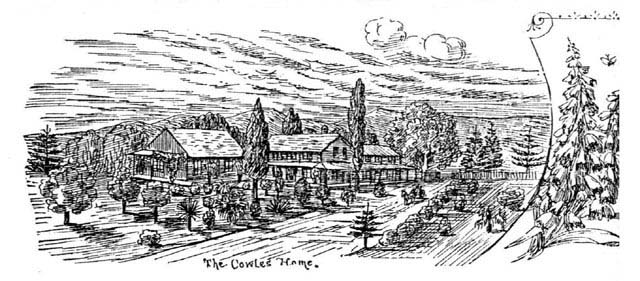
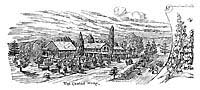
The Cowles Home
|
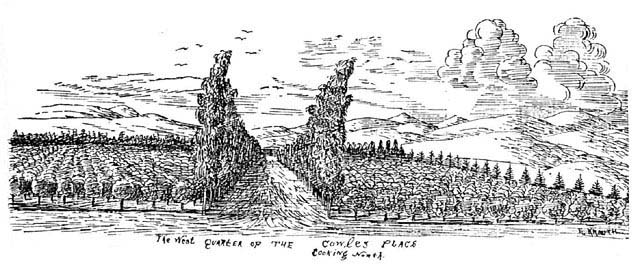
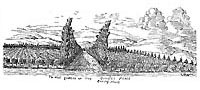
The West Quarter of Cowles Ranch
|
Arriving in San Diego already wealthy (but in noticeably poor health),
having knowledge and experience in farming, machinery, business and finance,
and with good planning and vision, Cowles accomplished much in the following
ten years until his death at age 51. The property he purchased eventually
totaled about 4,000 acres in the El Cajon valley (over 6 square miles of
land) and comprised two ranch sites about a mile apart. One was named "Woodside"
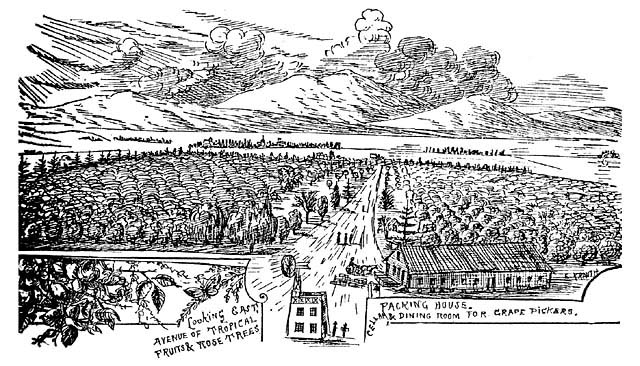
where the ranch house was located and the other, probably by their having
planted 17 Magnolia trees, was named "Magnolia" (today, street names Woodside
Ave in Santee and Magnolia Ave in El Cajon are from the Cowles ranches).
He planted a great variety of different fruit trees and grapevines, olives,
grains and potatoes. The greatest success was in raisins and olives.
Cowles' products gained nationwide attention for San Diego's farming potential,
particularly in fruits and vines, and he was called the "Raisin King of
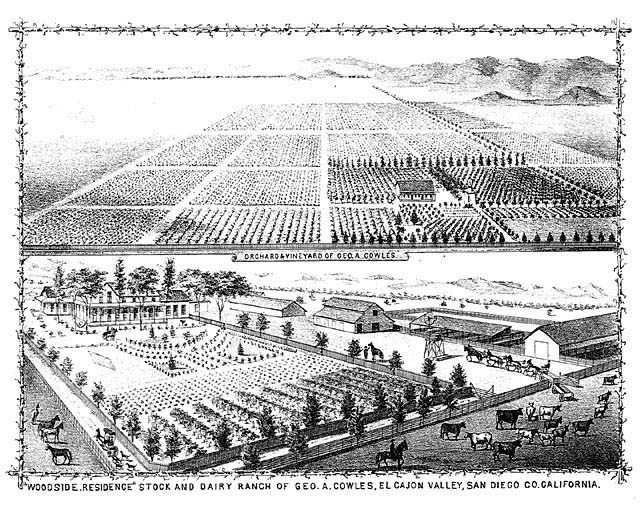
the US". He raised fine thoroughbred horses, maintaining about 100
head, and 30 head of cattle. The community that developed around
his Woodside ranch became known as Cowlestown.
George Cowles was an organizer of the Consolidated National Bank,
a director of the Commercial Bank, and vice president of the San Diego
County Savings bank. He also helped form, and was vice president
of the San Diego Marine Ways & Dry-dock Company on North Island, having
turned down the offer of presidency. Also a director of the California
Southern Railroad (later a part of Santa Fe), he was responsible for extending
the railroad from San Diego's 22nd Street Station into the north end of
El Cajon valley, including giving free right of way through his own property.
The Red Car trolley now runs on these tracks, and Highway 67 utilizes some
of the right of way as it turns east from Santee.
 |
|
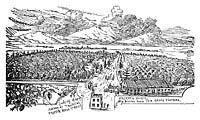
Cowles Magnolia Ranch
|
George A. Cowles died November 26, 1887 in his room at San Diego's
then premier Florence Hotel, succumbing after two weeks to an intestinal
ailment. He had just completed the railway negotiations, an effort
that some had said hastened his death. After a fine and well attended
funeral at a church in the new downtown San Diego, Cowles was buried in
the El Cajon valley. Two years later his remains were moved to the
Mount Hope Cemetery.
Having named both his wife, Jennie Cowles, and a trusted friend as
executors of his will, he left essentially all of his estate to Jennie
as they had no children. The estate was considerable, estimated between
$370,000 and $500,000 at that time (one comparison would be $15 - $20 million
in today's dollars). The year after his death, some of Cowles property
was subdivided and placed on the market as San Diego's land rush of the
1880's was ending. Jennie Cowles continued ranching into the 1890's.
She married Milton Santee in November of 1890, and prepared a residence
at 11th & B in "New Town" San Diego. Cowlestown's first school
was held in a large room at the Cowles ranch house. A new schoolhouse was
built on land Jennie had donated for the school.
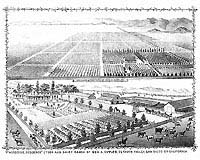 |
|
Late 1800's Lithograph of Cowles Ranches
|
Cowles town officially became Santee in 1893 named for Jennie Cowles'
second husband, Milton Santee, who was a real estate developer. The
name of Cowles School also changed to Santee. Cowles Spring eventually
lost its name Cowles and became Dog Spring. Cowles Mountain nearly
lost its name as well, becoming known as Black Mountain (even though there
already was one in the county), and "S" Mountain (because of the large
white "S" painted on by San Diego State students). The historically
significant name of Cowles Mountain was actively preserved by the Mission
Trails Regional Park.
-by Bill White '97
* * *