A Horse Coffin at Mission Trails Park?
by Bill White '97
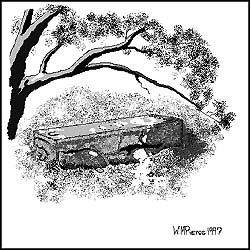 Identified
as "the grave" on a map in a recent document for a San Diego public utilities
project, a curious concrete block alongside Fr. Junipero Serra Trail begs
explanation. When something unusual is there, and remains long after
an explanation as to its origin seems lost, imagination tends to take over
and provide us answers based on the few clues left behind.
Identified
as "the grave" on a map in a recent document for a San Diego public utilities
project, a curious concrete block alongside Fr. Junipero Serra Trail begs
explanation. When something unusual is there, and remains long after
an explanation as to its origin seems lost, imagination tends to take over
and provide us answers based on the few clues left behind.
The "horse coffin", as it has come to be known, is a rectangular
concrete platform, the height of a bench, poured over a foundation of large,
irregular granite quarry boulders. It sits just off Fr. Junipero
Serra Trail about 30 yards from the river, and under the new growth of
an old oak tree. It is about 10 feet long, 4 feet wide, and decorated
on top with brass bullet casings which were pushed end-up into the cement
while it was still wet. Besides some numbers created in this way
at one end, and a two foot circle around a small hole in the center of
the platform, the unmistakable design of a horseshoe made with two rows
of shells is imbedded in the north end of the platform.
Well, a horse grave site makes sense. But while talking
history with my neighbor, long-time Allied Gardens resident Don Preddy,
he was reminded of a colorful old cowboy named Bill Aikins (spelling uncertain
at this writing), who had built a bench out of concrete and rock and had
made some designs in the concrete surface with gun shells. I say
old because Don, who is now in his 60's, was a boy of 15 or 16 when he
bicycled down Mission Gorge Road and came across Bill, then about 70.
Stepping back in time ... what is now Fr. Junipero Serra
Trail was once Mission Gorge Road. The "new" Mission Gorge Road cutting
between Kwaay Paay and Pyle's Peak did not exist. The old road was
narrow, one lane in each direction. It snaked along San Diego River
from Mission Valley at Fairmount, through Grantville, past a dairy at the
bottom of Zion Avenue, on out over open country and through the gorge that
is now a part of Mission Trails Park. This was the main road to Santee.
Often, on a particular day, during the 1930's and through
the 1950's, if you were looking for Bill Aiken you would be likely to see
his large, flowing, 1936 black Ford sedan sitting off Mission Gorge Road
about a quarter mile south of Old Mission Dam. It was parked in the
dirt, below the main road and above a concrete roadway that forded the
San Diego River. This was his favorite spot.
Laid out on the cement platform was an assortment of rifles,
pistols, gun cases, ammunition and reloading equipment. Don especially
remembered a pair of pearl handled Colt 45 six-shooters with 4 1/2" barrels.
They had been customized by removing the sight blades, and fitting a single
pearl bead on the tip of each pistol barrel instead.
Bill Aiken's appearance was that of an authentic cowboy. Dressed in an
old pair of Levi's and a loose shirt (Don couldn't remember if he wore
boots), he had a long white handlebar mustache turned way down at the ends
and long white hair almost to his shoulders. Pictures of Buffalo Bill Cody
come to mind.
Don told me, "What I remember most that impressed
me was the shooting demonstration Bill did for me that day. Facing
the other way, his pearl-handled 45's in their holsters, Bill had me set
up two tin cans on the slope near the concrete bench. On my signal,
"Draw! Bill." he spun around and drew both pistols. Boom ... boom
... boom. Shooting from the hip, he alternated firing his pistols,
hitting the cans with every shot as they danced across the slope.
He repeated this feat for me several times. I still remember that
... I was really impressed!"
On later visits to Bill's house, around Nile
and University, Don remembered seeing examples of the fine leather work
and scroll work that Bill had tooled. Also, in his small garage, he had
created a motorized shooting gallery for his own use. Now, a personal
shooting gallery in a residential neighborhood inside San Diego city limits
doesn't sound either particularly safe, or legal. Nevertheless, he
had a unique trick that helped him get away with it. The bullets
he used were fashioned by pressing empty brass shell cases into a paraffin
wax block. (Paraffin blocks were commonly available and normally
bought for use in home canning.) Only the charge in the firing cap
was needed to propel the wax bullets to the gallery targets. This
significantly reduced the noise created by firing the gun, and kept the
neighborhood free of stray bullets exiting the back wall of his garage!
Don's father had learned a little about Bill
Aiken's rather colorful past from conversations with him. Some of
Bill's adventures were legal, apparently some weren't ... quite.
Toward the end of his career, he was Chaplain at San Diego County Jail.
Finally, after many years, Bill hung up his guns for good. He was
in his 90's.
The "horse coffin" was made for the purpose
of convenience, a place to sit and lay out all of his things, according
to what Don remembered being told. The explanation Bill gave for
the decoration was vague, and isn't remembered except that the numbers
formed by the brass casings were 8-5-34, the date the bench was made.
Dates stamped on the shells that are embedded in the concrete are
mostly 1926 & 1927, the most recent being 1930.
I asked Don, "Is there a horse buried there?"
"I don't think so." he said.
- by Bill White 5/97
* * *


